
Spatial AI,
Edge AI-powered 3D conversion — without the cloud, without replacing existing equipment.
Turn Existing 2D Cameras into Real-Time 3D.
SDK / API / Licensing,Up to 30 FPS · Edge AI / CPU · Occlusion Correction · Glasses-Free 3D
Core technology
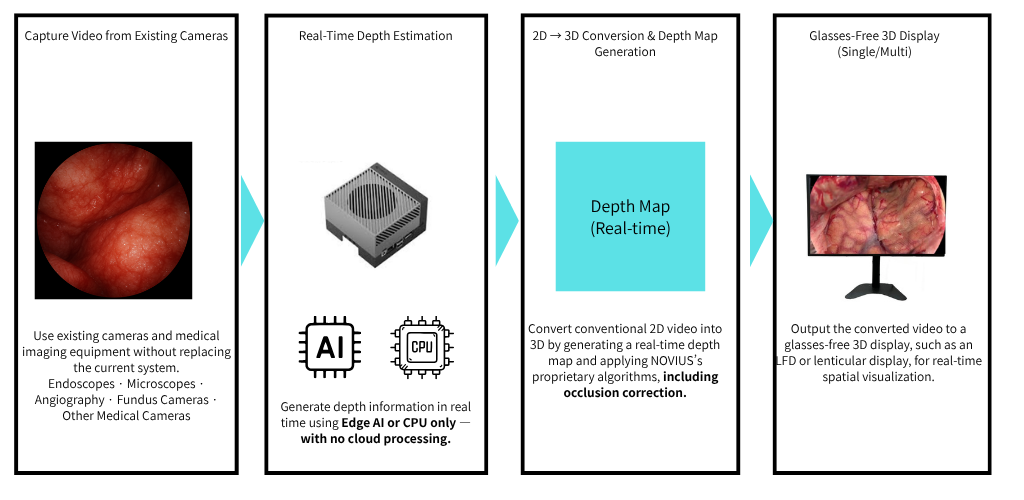
1.Use Edge AI
Generate depth information in real time using external Edge AI hardware processing, without cloud connectivity or cloud-based computation.
2.Existing Cameras & Equipment
Leverage existing cameras and imaging equipment without requiring system replacement. Generate 3D video from a single camera feed, with support for configurations using two or more cameras.
3. Real-Time Performance — 30 FPS
Support real-time 2D-to-3D conversion at up to 30 FPS, targeting a smooth display experience with minimal processing delay from video input to 3D output.
4. Glasses-Free 3D Displays
Compatible with glasses-free 3D displays, including eye-tracking-based solutions designed for both single-viewer and multi-viewer experiences across multiple displays.
5.Real-Time 3D Conversion with Audio
Flexible technology integration through SDKs, APIs, and licensing options for medical devices, imaging systems, display manufacturers, and software developers.
6.Real-Time 2D / 3D Object Differentiation
Distinguish selected objects from the surrounding scene and display them in 2D or 3D within the same 3D display environment, enabling flexible visualization of different objects in real time.
7. Automatic Occlusion Correction
Automatically correct occlusion artifacts and improve depth consistency when objects overlap or scene conditions change, including challenging situations such as sudden bleeding or gauze appearing during medical procedures.
8. SDK / API / Licensing
Flexible technology integration through SDKs, APIs, and licensing options for medical devices, imaging systems, display manufacturers, and software developers.
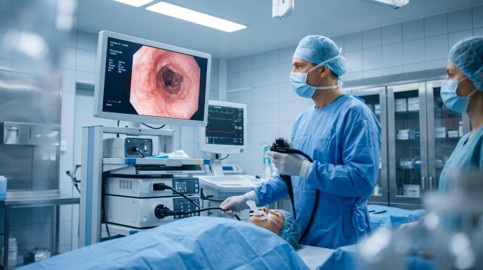
Medical and Healthcare
Endoscopy and Surgical Procedures: Converts real-time images of the digestive tract and body cavities into 3D, helping surgeons assess the depth of tissues and surgical instruments
This technology adds depth and spatial information to medical images to assist healthcare professionals in interpretation and procedures. Using AI, the system estimates depth, the front-to-back relationships of objects, and three-dimensional spatial relationships in real time from 2D images such as endoscopic, fluoroscopic, angiographic, and fundus images. We are also developing applications for 3D visualization, image analysis, and surgeon assistance systems.
- Endoscopy: Visualizes the depth and spatial relationships of mucosal surfaces, organs, and lesions in real time to aid in observation and treatment.
- X-ray fluoroscopy: Estimates the depth and spatial relationships of organs, catheters, and other structures to assist with interventional radiology (IVR) and device manipulation
- Angiography: Provides a three-dimensional view of the course, branching, and depth of blood vessels to assist with catheter manipulation and endovascular procedures
- Fundus Images: Estimate the three-dimensional structure and depth information of the retina, blood vessels, and lesions to support ophthalmic examinations and treatment
Industrial and Manufacturing Inspections
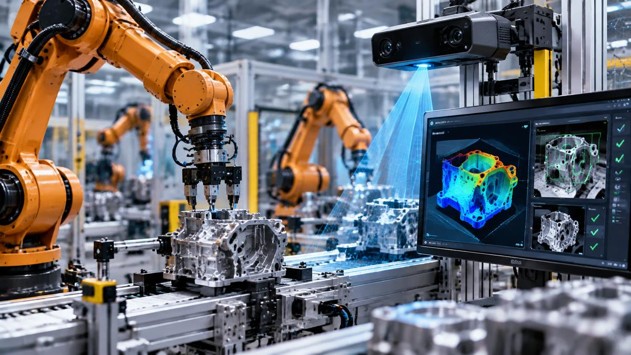
Enhancing Recognition Capabilities on the Manufacturing Floor by Incorporating Depth Information into Image Inspection
Based on camera footage from production lines and inspection equipment, the system estimates the position, shape, depth, and relative positions of parts. It can be applied to advance manufacturing processes, such as visual inspection, part positioning, anomaly detection, and robotic picking.
1. Visual and Quality Inspection Detection and evaluation of scratches, defects, deformation, foreign objects, and surface conditions on products and parts using AI
2. Dimensions, Shape, and 3D Inspection: Measure and verify the depth, height, shape, positional deviations, and assembly status of parts based on spatial data.
3. Recognizes the position, orientation, and relative alignment of parts on production lines and during robotic inspection in real time to support picking, assembly, transport, and robot control
In points 2 and 3 above, adding depth and spatial information to existing 2D camera footage has the potential to enhance conventional image recognition
Semiconductors (Back-end Processes)
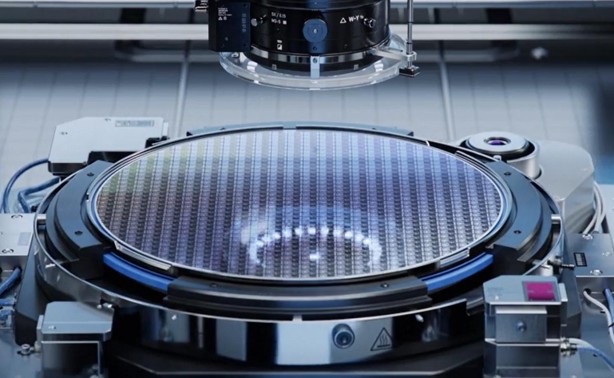
Enhancing Recognition Capabilities on the Manufacturing Floor by Incorporating Depth Information into Image Inspection
Based on camera footage from production lines and inspection equipment, the system estimates the position, shape, depth, and relative positions of parts. It can be applied to advance manufacturing processes, such as visual inspection, part positioning, anomaly detection, and robotic picking.
Main Areas of Testing
- Inspection of Chip Position, Tilt, and Mounting Condition
- Inspection of Wire Bonding and Joints
- Inspection of the Height, Shape, and Position of Bumps (Connection Terminals)
- Inspection of the Height, Shape, and Position of Bumps (Connection Terminals)
Automobiles
3D Navi(Real-Time 3D Navigation)
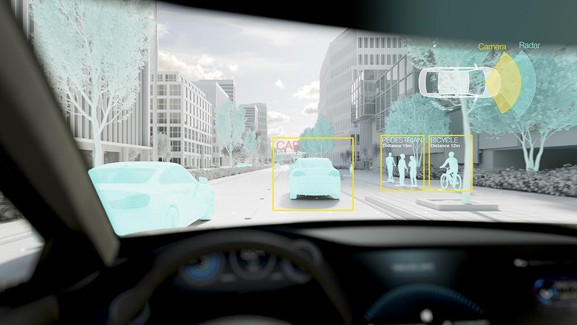
Based on footage from in-vehicle cameras, the system estimates the depth and spatial relationships of vehicles, pedestrians, obstacles, and the road environment. It is expected to find applications in environmental perception, driver assistance, in-vehicle displays, and next-generation mobility systems.
Improved Visibility of Potential Hazards: Displays pedestrians, bicycles, and vehicles in 3D, allowing for an intuitive understanding of the surrounding environment.Understanding Distance and Position: Makes it easier to recognize the relative front-to-back positions and depth between the vehicle and surrounding moving objects.Hazard Prediction Assistance: Helps drivers notice approaching pedestrians, bicycles crossing intersections, and other hazards more easily. Organizing Information While Driving: Keep the stationary background in 2D to make moving objects stand out.
Real-Time 3D Dash Cam
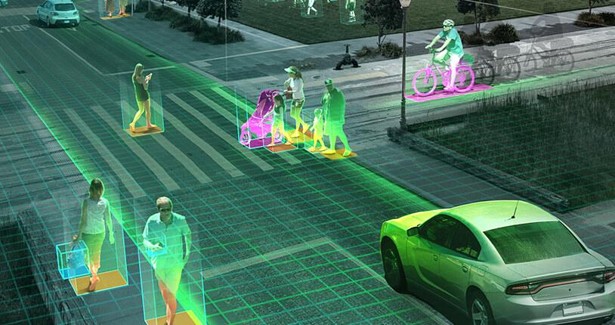
3D Dashcam: Records moving pedestrians, bicycles, and vehicles in real time as 3D models. It allows you to visually confirm the depth and relative positions of objects in three dimensions, helping you understand and analyze accident scenarios.
Three-Dimensional Recording of Hazardous Situations: Recording the movements of pedestrians, bicycles, other vehicles, and more as 3D video Understanding the Accident Situation: It is easy to visually understand the relative positions and sequences of vehicles, pedestrians, and bicycles.Visualization of Approaching and Interrupting Objects: Makes it easier to understand the movements and relative positions of nearby moving objects Advanced Accident Analysis: In addition to standard 2D footage, it enables three-dimensional assessment of the situation using depth information.
Robotics
AI understands spatial relationships in the real world and translates them into robot movements
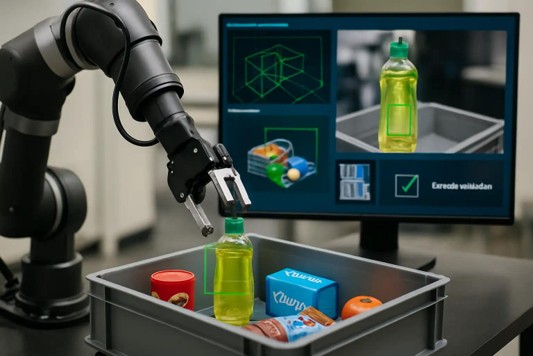
Based on images from a monocular camera, the system estimates the position and depth of objects, as well as their relative positions relative to the robot, in real time. It is utilized for tasks such as picking, transport, positioning, and verification of work results performed by the robot arm, with the goal of realizing an autonomous system that repeatedly performs recognition, decision-making, motion, and verification. .
In robotics, there are methods for acquiring spatial information using stereo cameras, LiDAR, RGB-D cameras, and other devices. Our company, on the other hand, is able to estimate depth from existing monocular RGB camera footage.NVIDIA provides the computing infrastructure that powers AI, while our company provides a real-time AI engine that enables robots to understand their surroundings.It is possible to integrate Novias' technology into the NVIDIA ecosystem.
Let’s Explore What’s Possible.
Discuss your challenge with our technology team and explore a PoC, technical validation, or collaboration.